Last Updated: October 23, 2026
Quick Summary
A winter furnace checklist in New Jersey starts with replacing the air filter, testing the thermostat, clearing space around the unit, and sealing drafts in early fall. Before the first freeze, schedule a professional heating tune-up and safety inspection, then check the filter and listen for odd sounds monthly through winter.
- Check the filter monthly and replace it every one to three months, sooner in homes with pets or heavy winter use.
- A healthy burner flame burns steady and blue; a yellow, flickering, or lifting flame means stop and call a professional.
- Install carbon monoxide detectors on every level and near sleeping areas, and test them monthly.
- Leave burner cleaning, heat exchanger checks, gas pressure testing, and flue work to a licensed technician.
- Call for emergency service if you smell gas, hear banging or scraping, see soot, or a CO detector sounds.
Table of Contents
- Why a Winter Furnace Checklist Matters in New Jersey
- Your Furnace Maintenance Checklist, Start to Finish
- Furnace Filter Replacement: The Step Most Homeowners Skip
- Thermostat Settings for Winter That Keep Bills Steady
- What a Furnace Safety Inspection Covers
- Carbon Monoxide and Combustion: The Checks You Should Never DIY
- Seal Drafts, Check Ductwork, and Protect Airflow
- Troubleshooting and When to Call for Emergency Service
- Frequently Asked Questions
Why a Winter Furnace Checklist Matters in New Jersey
A winter furnace checklist in New Jersey is not busywork. It is the difference between a warm house in January and a cold one waiting on an emergency call. Our state winters swing hard: mild stretches, then a fast drop into the teens, often with wind that pushes cold straight through older walls.
That pattern is tough on heating equipment. A furnace that coasted through fall can fail on the first truly cold night, when every technician in the county is already booked. This guide from General Air Pro walks you through a practical, sequenced checklist you can start today.
Below, we break the work into fall tasks, monthly checks, and the jobs that belong to a licensed technician. Do the homeowner-safe items yourself. Leave combustion and gas work to a pro.
If your system is older and you are weighing repair against replacement, our guide on whether to squeeze one more winter out of an old heating system walks through that decision before the first freeze.
Your Furnace Maintenance Checklist, Start to Finish
A furnace maintenance checklist works best in a fixed order. Start with the simple visual checks, move to filters and airflow, then finish with a professional inspection before the cold settles in.
Here is the sequence we recommend for most homes:
| Timing | Task | Who Does It |
|---|---|---|
| Early fall | Replace or clean the air filter | Homeowner |
| Early fall | Test the thermostat and run heat | Homeowner |
| Early fall | Clear space around the furnace and vents | Homeowner |
| Early fall | Seal drafts and check ductwork | Homeowner |
| Before first freeze | Professional heating tune-up and safety inspection | Licensed technician |
| Monthly | Check filter, listen for odd sounds, watch the flame | Homeowner |
That table is your map. The sections below explain each step in detail.
Fall Tasks: What to Do Before the First Cold Snap
Start with the air filter. A clogged filter chokes airflow, and a furnace that cannot breathe runs hotter and works harder. Pull the old one, hold it up to a light, and replace it if you cannot see through it.
Next, test the thermostat. Switch it to heat and raise the set point a few degrees. You should hear the system start within a minute or two. If nothing happens, check the breaker before you assume the worst.
Then clear the area. Move boxes, paint cans, and stored items away from the furnace. Keep the area around it open so air can move.
Finally, walk the house and seal obvious drafts around windows and doors. That keeps the heat you are paying for inside.
For a deeper local walkthrough, see our furnace maintenance guide for Edison homeowners, which covers the warning signs that mean repair is needed.
Monthly Tasks Through Winter
Once winter arrives, a short monthly routine keeps small issues from becoming emergencies. Set a reminder on your phone for the first of each month.
- Check the filter and replace it if it looks gray or matted.
- Listen at startup for grinding, squealing, or banging.
- Look at the burner flame through the sight glass if your unit has one.
- Confirm warm air is reaching every room.
- Test smoke alarms and carbon monoxide detectors.
A healthy burner flame burns steady and blue. A yellow, flickering, or lifting flame is a signal to stop and call a professional. Do not ignore it.
Furnace Filter Replacement: The Step Most Homeowners Skip
Furnace filter replacement is the cheapest maintenance you will ever do, and the one most people forget. A dirty filter restricts airflow, which raises energy use and shortens the life of the blower motor.
The rule of thumb: check it monthly and replace it every one to three months. Homes with pets, allergies, or heavy winter use should lean toward the shorter end. If you run a thicker pleated filter, follow the manufacturer's interval instead.
Here is how to swap it correctly:
- Turn the furnace off at the switch or breaker.
- Slide out the old filter and note the size printed on the frame.
- Match the airflow arrow on the new filter to the direction printed on the unit.
- Slide it in, close the cover, and restore power.
A common mistake is installing the filter backward. The arrow points in the direction of airflow, toward the blower, not toward the return duct.
Thermostat Settings for Winter That Keep Bills Steady
Thermostat settings for winter come down to one idea: steady and moderate beats dramatic swings. Pick a comfortable daytime temperature, set it lower while you sleep or while the house is empty, and let the system hold there.
A programmable or smart thermostat does this for you. Set a schedule once and stop fiddling with the dial. Every big setback and recovery cycle makes the furnace work harder to catch up.
A few habits that help:
- Keep the fan on "auto" rather than "on" to save energy between cycles.
- Avoid cranking the heat way up to warm a room faster. It does not speed anything up.
- Keep furniture and rugs clear of vents and returns.
- Change the filter on schedule so the system is not fighting restricted airflow.
If your bills still climb, the problem may be the building, not the thermostat. Our guide on how to lower energy bills covers the deeper steps, from insulation to air sealing.
What a Furnace Safety Inspection Covers
A furnace safety inspection is a professional check of the parts you cannot safely test yourself. It confirms the system is burning fuel correctly, venting exhaust outdoors, and running within safe limits. The useful question is not just what gets checked, but what a thorough inspection actually looks like and what should make you ask questions.
A thorough inspection typically covers:
- Burners and ignition components: cleaned and checked for proper light-off and flame shape.
- Heat exchanger: inspected for cracks that could leak combustion gases into the living space.
- Flue and venting: checked for blockages, corrosion, proper slope, and backdrafting.
- Electrical connections and controls: tightened and tested, including safety switches and limit controls.
- Gas connections: checked for leaks and correct pressure.
- Blower and airflow: measured and adjusted, with the filter and ductwork considered.
- Condensate drain and pump: checked where the unit has one, since a clogged drain can shut the system down.
- Clearances: confirmed against the manufacturer's data plate so combustible storage and the cabinet itself are not a hazard.
- Carbon monoxide test: confirming safe readings in the living space and at the supply registers.
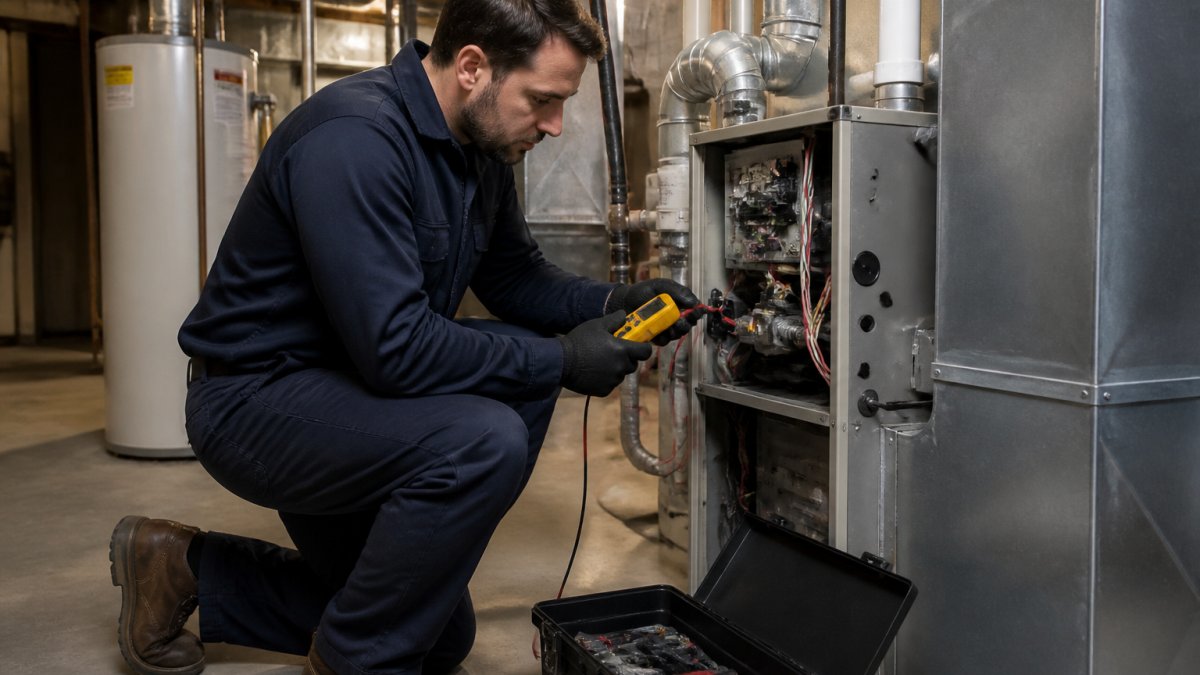
A few things separate a real inspection from a quick look. The technician should remove and clean the burners rather than just peer at them, should test the heat exchanger with more than a flashlight, and should leave you with readings, combustion analysis numbers and a CO reading, not just a verbal "looks good." Ask what was measured and what the numbers were.
This is also the point to ask about efficiency upgrades and any utility rebates that may apply to your equipment. Rules and amounts change, so confirm current details with your utility and a licensed contractor.
If you want to understand what services involve before you call, our page explains what affects the final quote and how to request a free estimate.
Carbon Monoxide and Combustion: The Checks You Should Never DIY
Carbon monoxide is the reason some furnace work is not a homeowner job. It is colorless and odorless, and it comes from incomplete combustion. Adjusting burners, gas pressure, or venting without training and instruments is genuinely dangerous.
Here is the line we draw:
Safe for homeowners:
- Replacing filters
- Testing thermostats
- Clearing space around the unit
- Testing CO and smoke detectors
- Visual checks of the flame
Work for a licensed technician:
- Cleaning or adjusting burners
- Checking the heat exchanger for cracks
- Testing gas pressure and combustion readings
- Any work on the flue or venting
- Electrical repairs inside the unit
Install carbon monoxide detectors on every level of your home and near sleeping areas, and test them monthly. If a detector alarms, get everyone outside and call for help before you investigate.
The [U.S. Environmental Protection Agency's indoor air quality guidance | epa.gov] explains why combustion appliances need proper venting, and the [U.S. Consumer Product Safety Commission | cpsc.gov] publishes CO safety guidance worth reviewing each fall.
Seal Drafts, Check Ductwork, and Protect Airflow
Air sealing and ductwork checks protect the heat your furnace produces. A sealed house holds warmth; a leaky one sends it outside while your system runs longer to compensate.
Start with the obvious drafts. Feel around windows, doors, outlets, and the rim joist in the basement on a windy day. Weatherstripping and caulk handle most of it cheaply.
Then look at the ductwork you can reach:
- Check joints for gaps and loose tape.
- Look for crushed or disconnected flex duct in the basement or attic.
- Confirm every supply register is open and unobstructed.
- Make sure return grilles are not blocked by furniture.
Poor airflow is one of the most common reasons a room stays cold while the rest of the house is fine. If ducts run through an unconditioned attic or crawlspace, insulation matters as much as sealing.
Troubleshooting and When to Call for Emergency Service
Troubleshooting starts with the simple stuff. No heat at all? Check the thermostat batteries, the breaker, and the filter first. Short cycling? A restricted filter or a failing sensor is a common cause.
Try these before you call:
- Confirm the thermostat is set to heat and the set point is above room temperature.
- Replace the filter.
- Check the breaker and the furnace power switch.
- Confirm the gas valve is on if you have a gas furnace.
- Clear any blocked vents or returns.
Stop and call for emergency service if you smell gas, hear banging or scraping, see a yellow flame or soot, or a CO detector sounds. Those are not DIY problems.
For homeowners in the Edison area, our team handles furnace repair in Edison with licensed technicians and free estimates. We also cover North Arlington, Bergen County, Princeton, Mercer County, and communities across Middlesex County.
Winter in New Jersey does not forgive a neglected furnace. Work through this checklist now, while the weather is mild, and you will head into the cold season with a system you trust.
When a professional inspection or repair is the next step, General Air Pro is ready. We bring over 15 years of experience, licensed and insured technicians, upfront pricing before any work begins. We serve homes and businesses across North and Central Jersey.
Get your free quote from General Air Pro and head into winter with heat you can count on.
Frequently Asked Questions
What should be included in a winter furnace checklist?
A solid winter furnace checklist covers filter replacement, a thermostat test and winter settings, a visual inspection of the burners and flame, cleaning around the equipment, checking electrical connections and system controls, inspecting ductwork and airflow, and sealing drafts. It should also include a professional furnace safety inspection before the heating season, plus testing smoke alarms and carbon monoxide detectors. Split the work into fall tasks and monthly checks so nothing gets skipped once the cold settles in.
How often should a furnace be serviced?
Schedule a professional heating tune-up once a year, ideally in early fall before the first cold snap. A technician can clean components, inspect the burners and ignition parts, test system controls, and measure combustion to confirm safe operation. Between visits, replace the furnace filter every one to three months depending on the filter type and household conditions, and run a quick thermostat test monthly. Annual service keeps the heating system reliable and catches small issues before they turn into winter breakdowns.
What temperature should a home be in winter?
Most households do well with thermostat settings for winter around 68 to 70 degrees Fahrenheit while people are awake and home, then a few degrees lower overnight or when the house is empty. Lowering the setpoint slightly for long stretches reduces energy use without making rooms uncomfortable. Keep the setting steady rather than swinging it up and down, and avoid setting it very low in freezing weather, since pipes and interior walls in older homes can suffer. A programmable or smart thermostat makes these adjustments automatic.
When should you call an HVAC professional about a furnace problem?
Call a professional if you smell gas, notice soot or a yellow burner flame instead of a blue one, hear banging or scraping from the unit, or see the furnace short-cycling. Any carbon monoxide alarm should trigger an immediate call and evacuation. If the heat simply will not come on after a thermostat test and filter change, that also warrants a service visit. For no-heat emergencies in freezing weather, contact an HVAC professional promptly rather than waiting, since a cold house can put pipes at risk.
